
We introduce machining examples of zirconia.
Compared to alumina, which is also an oxide, zirconia is more difficult to manufacture in large sizes and has higher material cost. Therefore, it is mainly used for relatively small components requiring high flexural strength and high fracture toughness (resistant to cracking and chipping).
Zirconia (ZrO₂)
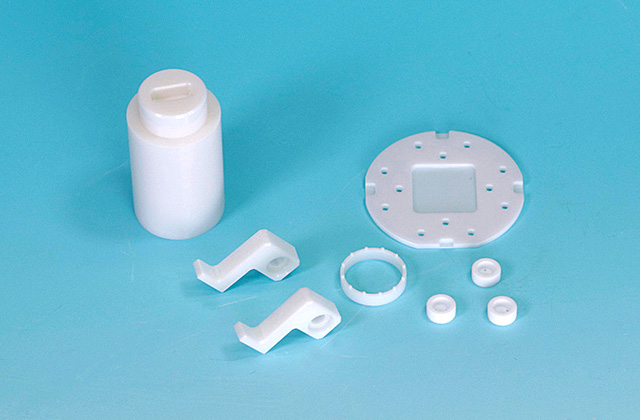
High Toughness · Wear Resistance · Low Thermal Conductivity
Typical properties of zirconia
| Item | Vickers Hardness HV (GPa) |
Flexural Strength (MPa) | Fracture Toughness (MPam¹/²) |
Maximum Service Temperature (℃) | Coefficient of Thermal Expansion (×10-⁶/℃) |
Thermal Conductivity (W/(m·K)) |
Thermal Shock Resistance (℃) | Chemical Resistance |
|---|---|---|---|---|---|---|---|---|
| Chemical Formula·Purity | ||||||||
| ZrO₂ | 13 | 1000 | 6 | Not suitable for long-term use at high temperatures | 7.7 | 3 | 280 | Relatively Good |
Applications Utilizing Material Properties
| Item | Features | Applications |
|---|---|---|
| High Density |
· High Flexural Strength and Fracture Toughness · Resistant to Chipping, Cracking, and Breaking · High Impact Resistance |
· Components Subject to High Loads · Especially Suitable for Impact Resistance · Example: Ceramic Knives |
| Low Thermal Conductivity | · Low Thermal Conductivity with Insulation Effect | · Thermal Insulation Components |
| Good Chemical Resistance | · Resistant to Acids and Alkalis | |
| Good Wear Resistance | · High Toughness with Good Wear Resistance | · Wear-Resistant Components |
Machinable Sizes
| Item | Sizes (mm) | Item | Sizes (mm) |
|---|---|---|---|
| Plate Dimensions | Φ300 × 30 | Hole Diameter | Φ0.2– |
| Rod Dimensions | Φ50 × 300 | Hole Depth | –150 |
| Grooves | Width 0.1– | Number of Holes | –100 |
| Steps (Protrusions / Recesses) | –30 | Threads | M2– |