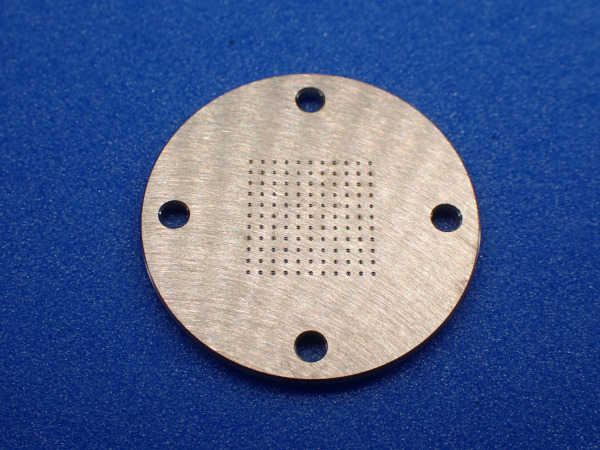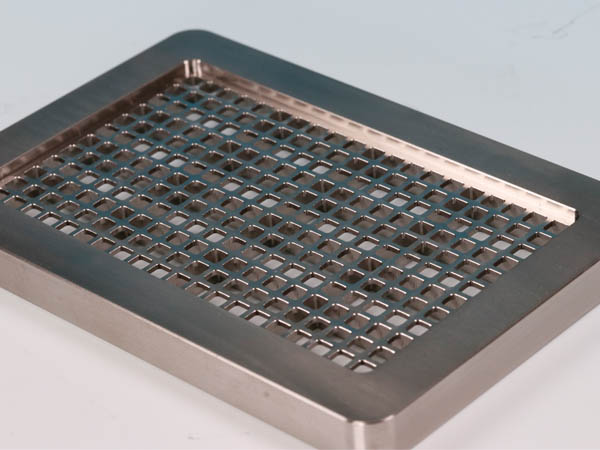
This section introduces applications of processing using titanium.
Titanium is a material with excellent high strength and light weight. Compared to iron, it is approximately twice as strong and about half as light. Furthermore, its stable oxide film provides high corrosion resistance, particularly in seawater. It is non-toxic, highly biocompatible, and resistant to degradation over time, making it suitable for recycling. It is known as a widely used material that is kind to both people and the environment. Tensile strength varies depending on the type, and alloys are also available.
Titanium (Ti)
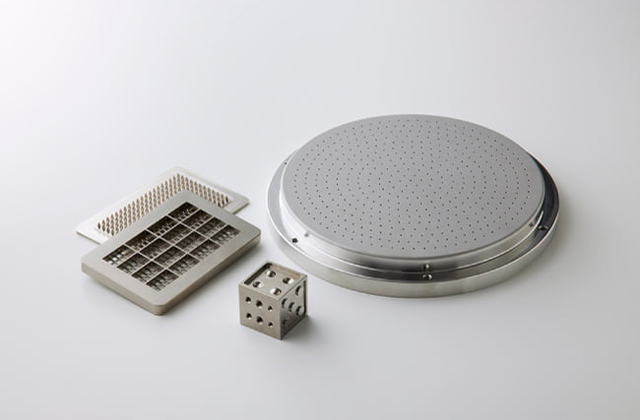
High Strength · Lightweight · Machinability · Corrosion Resistance · Biocompatibility
Typical properties of titanium
| Item | Purity (%) |
Bulk Density (g/㎤) |
Young’s Modulus (GPa) |
Melting Point (℃) |
Coefficient of Thermal Expansion (10-⁶/℃) |
Thermal Conductivity (W/(m·K)) |
Volume Resistivity (Ω・㎝) |
|---|---|---|---|---|---|---|---|
| Chemical Formula | |||||||
| Pure Ti | 99.4 | 4.51 | 106 | 1,668 | 8.4 (RT) |
17.1 (20℃) |
47~55 ×10-⁶/℃ (20℃) |
Applications Utilizing Material Properties
| Item | Features | Applications |
|---|---|---|
| High strength Lightweight |
· Because it has high tensile strength and is flexible, it will not crack or break under impact. · It has a particularly low specific gravity among metals. |
· Parts requiring high strength · Parts that requiring weight reduction · Parts requiring corrosion resistance |
| Good Machinability | · Good machinability allowing complex shapes | |
| Corrosion resistance Excellent biocompatibility |
· It has particularly excellent corrosion resistance to seawater. · A metal that is less likely to cause metal allergies and is harmless to the human body. |
Machinable Sizes
| Item | Sizes (mm) | Item | Sizes (mm) |
|---|---|---|---|
| Plate Dimensions | 500 × 800 × 30 | Hole Diameter | Φ0.03– |
| Rod Dimensions | Φ100 ×500 | Hole Depth | –300 |
| Grooves | Width 0.1– | Number of Holes | –10,000 |
| Step | –100 | Threads | M1.2– |